
Mandatory surveys and legal documents for a sale in the Gers: the checklist before signing the compromis
Before selling in the Gers, gather the right surveys and paperwork to avoid delays, reassure the buyer and secure the compromis de vente.

- Your dossier de diagnostic technique should be ready before, or as soon as, the property goes on the market, not at the last minute.
- In the Gers, you need to pay close attention to the risk report, non-mains drainage and older installations.
- The legal documents most likely to hold things up are often the title deed, the taxe foncière, records of works carried out and paperwork relating to the land.
- A complete file makes viewings smoother, limits renegotiation and helps secure the compromis de vente with the notaire (French conveyancing solicitor and public official).
Which mandatory surveys should you prepare before selling in the Gers?
Before selling in the Gers, you need to prepare a dossier de diagnostic technique, tailored to the type of property, its year of construction and its location. For a house in the Gers, especially an older or rural one, the right approach is to check the DPE (French energy performance certificate), the installations, the risk report and, where relevant, the non-mains drainage system as early as possible.
« These surveys must be brought together in a file called the dossier de diagnostic technique (DDT). » Source: Service-Public.fr, « Quels sont les diagnostics immobiliers à fournir en cas de vente d’un logement ? », page checked on 7 March 2025.
In the Gers, we often see the same scenario: a beautiful stone house that looks very appealing on a viewing, but with an outdated consumer unit, an ageing gas boiler or a septic system that needs attention. That is why it is better to arrange the surveys before the first serious viewings even begin. You will save time and avoid a tense negotiation when it comes to the compromis de vente (pre-sale agreement). If you also want to prepare more thoroughly for selling your property in the Gers, this stage is a key part of the process.
- DPE: essential in most sales, it gives the property’s energy rating. For a house rated E, F or G, an energy audit may also be required.
- Lead: required if the property was built before 1 January 1949.
- Asbestos: required if planning permission predates 1 July 1997.
- Electricity and gas: mandatory if the installation is more than 15 years old, which is common in older Gers properties.
- Risk report: this depends on the commune and zoning, particularly for natural, mining, seismic or radon risks.
- Termites: only if the property is in an area covered by a prefectural order.
- Non-mains drainage: a major point to watch for any rural house with a septic tank or independent system.
| Diagnostic | When to arrange it | Validity |
|---|---|---|
| DPE | Sale of a home, except in specific cases | 10 years for DPE reports carried out since 1 July 2021 |
| Electricity | Installation more than 15 years old | 3 years |
| Gas | Installation more than 15 years old | Less than 3 years old at the preliminary contract or completion |
| Risk report | Property located in an area or perimeter exposed to risks | Less than 6 months |
| Termites | Area covered by a prefectural order | 6 months |
| Non-mains drainage | House with an independent system | Less than 3 years old at final completion |
In rural areas, the most practical issue is often drainage. An unfavourable SPANC inspection does not always prevent a sale, but it does change the conversation, because the buyer knows they will need to budget for works. The same applies to a risk report that needs updating if completion is delayed, or to a termite report that expires between the offer and the compromis de vente. In practice, it is far better to have the surveys dated at the right time by a certified surveyor than to redo them in a rush.

Which legal documents should you gather to secure the compromis and the final deed of sale?
To secure the compromis de vente and then the final deed of sale, you need far more than the surveys alone: the notaire and the buyer need documents that prove ownership, describe the property precisely and clarify its administrative position. A complete file, prepared in advance, avoids back and forth, reassures the buyer and limits last-minute hold-ups.
In the Gers, this is often the stage where sales begin to slow down. A village house with an unmarked courtyard, a former barn converted without clear records of the works, or a rural property with independent drainage and shared access can seem straightforward on paper, then become more delicate when the compromis de vente is being prepared. If you want to gather all the information you need calmly before launching a sale, it is best to open this file as soon as the property goes on the market, not after an offer has been accepted.
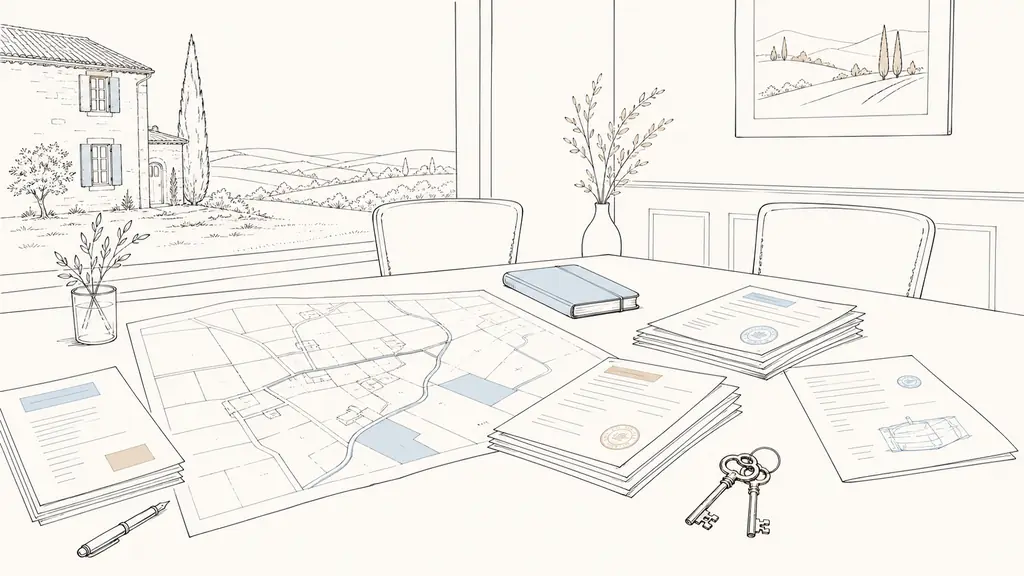
Here is the most useful checklist to pass on to the notaire, and often to show the buyer as well to keep discussions moving smoothly:
- the title deed, or failing that the notarial certificate, to prove ownership
- the sellers’ identity documents, civil status details and, depending on the case, the family record book, marriage contract or documents relating to an inheritance
- the taxe foncière notice, looked at closely in the Gers to assess the true annual cost of the property
- the cadastral references and, if you have them, a cadastral plan or any document that makes the boundaries easier to understand
- the boundary survey, if one exists, particularly useful for houses with a garden, shared access, a rural track or an adjoining plot
- any known easements, for access, water abstraction, utilities or rights to light, which are common in older and rural properties
- planning documents, prior declaration, planning permission, certificate of compliance or proof that works were completed
- invoices for works, especially for the roof, drainage, joinery or energy-efficiency renovation
- the latest non-mains drainage inspection if the property is not connected to the mains sewer
- co-ownership documents if the property is part of a lot, including the regulations, division statement, latest AGM minutes, service charge amount and maintenance log
This file is also there to bring any grey areas into the open before they harden the negotiation. An older extension that was never regularised, an undeclared swimming pool, access via the neighbouring plot or a boundary known only from memory will not necessarily block a sale, but they do need to be clarified early. For the general framework of the documents required, the Ministry of the Economy sets out the information that must be given to the buyer in a property sale (economie.gouv.fr, page consulted in March 2025).
FAQ
When should you arrange the surveys to sell in the Gers?
Ideally, you should arrange them before the property goes on the market or as soon as you start preparing the listing, to avoid delaying the compromis de vente and to give buyers the right information.
Which surveys are the most sensitive for an older house in the Gers?
The DPE, electricity, gas, lead, asbestos depending on the age of the property, the risk report and sometimes the non-mains drainage inspection are often the points examined most closely.
Can the seller provide some documents themselves?
Yes, some items such as the risk report come from official sources, but regulated technical surveys must be carried out by a certified surveyor.
Which papers should you ask the notaire or the estate agent for from the outset?
The title deed, cadastral references, taxe foncière, invoices for works, any easements, any surveys already carried out and, for co-owned property, the building documents.

Faye Gagnon rédige des contenus clairs et utiles pour aider les lecteurs à mieux comprendre l’immobilier dans le Gers et en Gascogne. Attentive aux réalités du terrain, elle s’attache à rendre accessibles les sujets liés à l’achat, à la vente et à la vie locale avec un ton chaleureux et fiable.
Envie d'aller plus loin ?
Laisse ton email, on te prévient dès qu'un nouvel article sort.